What Your Cabin Budget Actually Buys in Honobia and Clayton
The Hochatown short-term rental license you were planning around does not follow you north. The moment a buyer crosses out of the incorporated Town of Hochatown, the Granicus licensing portal, the lodging tax remittance schedule, and the built-in nightly demand that justifies a seven-figure cabin all fall away at the same time. That is the single fact that reshapes every price comparison between Hochatown and the Kiamichi Mountains communities of Honobia and Clayton about 25 to 45 miles north.
Buyers arrive at this comparison because the acreage math looks impossible. A wooded five-acre lot inside a gated Kiamichi preserve lists for the price of a Hochatown driveway. The obvious question is what the catch is. The honest answer is that there is no catch in the property itself. The catch is in the revenue model.
Portal medians tell a clean story that is mostly wrong for this corridor. Honobia and Clayton are not underpriced Hochatown. They are a different asset class priced against a different buyer.
| Metric | Hochatown corridor | Honobia | Clayton |
|---|---|---|---|
| Typical buyer | STR investor, luxury second-home | Recreational, off-grid, hunter | Lake retreat, retiree, weekender |
| STR licensing | Required through Granicus portal since Oct 1, 2024 | None in unincorporated Pushmataha/Le Flore areas | None outside city limits |
| Average land price | Premium tied to nightly demand | Roughly $11,900 per acre across active listings in mid-2026 | Median land listing in the low $300Ks |
| Anchor amenity | Broken Bow Lake, Beavers Bend | Three Rivers WMA, Kiamichi Mountains | Clayton Lake State Park, Sardis Lake |
| Rental demand | Deep, year-round, saturated | Thin, event-driven | Thin, seasonal |
The Hochatown town government partnered with Granicus to enhance services for its short-term rental market and stopped working with Avenu effective October 1, 2024, and the new licensing infrastructure is being rolled out in two stages through a longer-term enhanced portal. Nothing equivalent exists in unincorporated Honobia or in Pushmataha County around Clayton. That regulatory silence is not a loophole. It reflects the fact that these communities do not have enough transient lodging demand to build a tax base around.
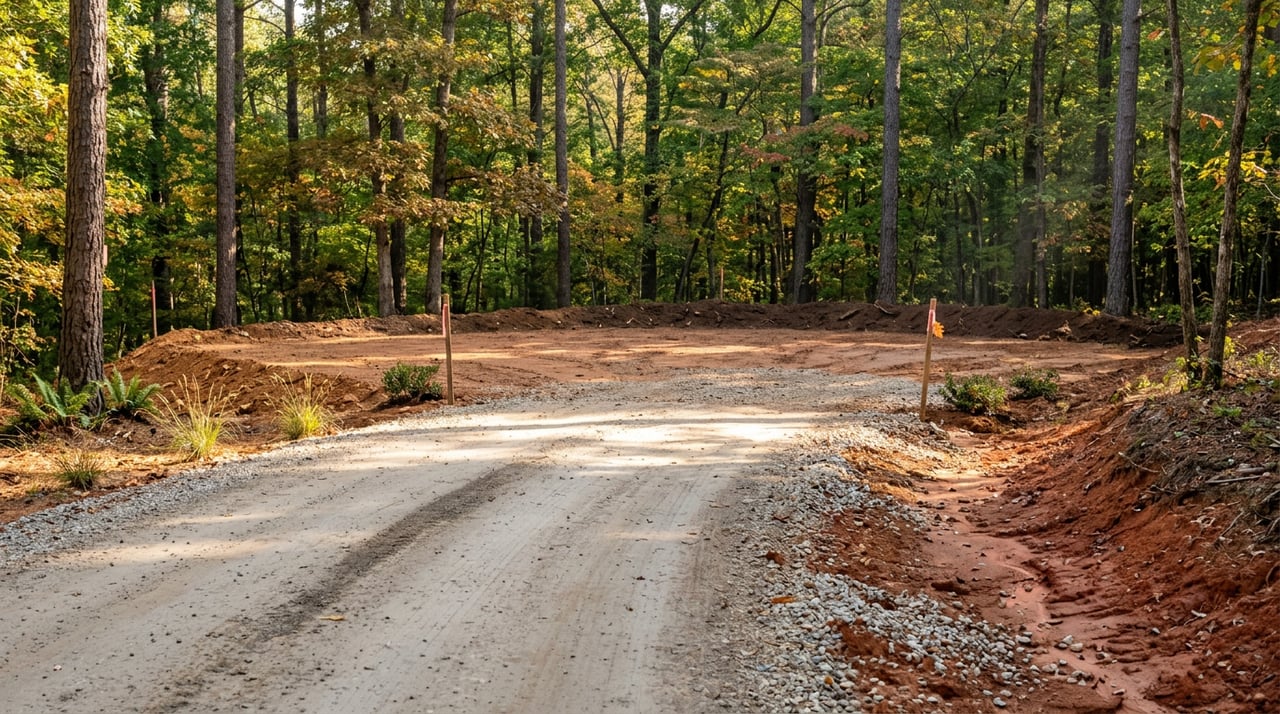
The most concrete way to see the Honobia value proposition is through the largest active development in the area. The Preserve at Boktuklo Mountain is a gated, 1,229-acre community with roughly 12 miles of internal gravel roads and lots that border the Three Rivers Wildlife Management Area to the south.
Recent active listings in the Preserve give a real picture of what a lot costs today:
Compare that against the Hochatown corridor, where a $60,000 budget buys a build-ready lot only in the least accessible pockets and where finished cabin comps routinely price in the seven figures. The story of one Hochatown cabin nicknamed California Dreaming makes the point sharply: it initially sold for $590,000 in 2020, climbed to $1.1 million in 2021, peaked at $1.299 million in 2022, and had later been listed at $899,000. Cabins in Honobia and Clayton do not swing on that curve because they were never priced against nightly demand in the first place.
The temptation for a buyer used to the Hochatown pro forma is to underwrite a Honobia or Clayton cabin as a lower-cost STR with lower-cost revenue. The math almost never works. Peak weekends in the Kiamichi Mountains are driven by a handful of events. The Bigfoot at the Forty Festival and Conference at Christ's Forty Acres on Highway 144 in Honobia is the largest of them, and even that 2026 event runs only three days, October 2 through 4. Outside of a handful of fall weekends and hunting season, cabins here compete against a state park lodging inventory and thousands of Broken Bow rentals an hour south.
The realistic underwriting is inverted from Hochatown. A Honobia or Clayton cabin should pencil as a personal-use property with optional rental upside during the roughly six weeks a year that support premium nightly rates. Anyone modeling it the other way is applying a Broken Bow assumption to a market that does not produce Broken Bow bookings.
That inversion is the thesis. The acreage discount north of Hochatown is not a bargain, it is the price of a market where short-term rental demand does not exist at scale. The buyers who win here underwrite the land for what they will personally use and treat every booked night as surplus.
A recreational-land transaction in this corridor is not a Hochatown transaction with lower numbers. It has a different diligence checklist. The items below tend to catch buyers who assumed otherwise.
None of these items appear on a portal listing. Every one of them can move a buyer's total cost of ownership by five figures.
Clayton reads more like a small-lake retreat market than a mountain-preserve market. Its anchor is Clayton Lake State Park in the Kiamichi Mountains, five miles south of Clayton, with 20 reservable RV sites, 60 first-come tent sites, three primitive cabins, and one two-bedroom family cabin, and it sits within easy reach of Sardis Lake. The lake itself is 80 acres, open to fishermen and boaters, with no watersports allowed, which sets the tone for the surrounding cabin market. Buyers should not expect Broken Bow Lake nightly rates on a no-wake lake with a quiet-hours ethos.
Where Clayton competes well is on entry price for a habitable cabin on real acreage with lake and state-park amenities minutes away. Where it does not compete is on rental yield or resale liquidity. The pool of qualified buyers when it comes time to sell is smaller than in Hochatown by an order of magnitude, and days on market reflect that in every reporting period.
Three profiles consistently make sound purchases in Honobia and Clayton:
The buyer who does not win is the one running a Hochatown STR pro forma with Honobia inputs. That model does not close the gap between the two markets. It confirms the gap.
Can I short-term rent a Honobia cabin without a license? Unincorporated portions of the Kiamichi communities do not currently operate a Hochatown-style STR licensing regime. County and state lodging tax obligations still apply, and platforms may collect some of those at the point of sale. Confirm current requirements with the county assessor and the Oklahoma Tax Commission before you list.
How does the Preserve at Boktuklo compare to buying raw acreage nearby? Preserve lots trade at a premium to comparable raw acreage because gated access, internal roads, and covenants are already in place. Raw tracts can be cheaper per acre but often require a private road agreement, utility extensions, and a longer approval path with the county.
What does a realistic cabin build cost here? Costs vary widely with road access, well depth, and off-grid components. A conservative approach is to secure firm bids from two Pushmataha or Le Flore County builders before you finalize a land purchase, and to underwrite the total project rather than the lot in isolation.
The Honobia and Clayton markets reward buyers who understand what they are actually buying. If you are weighing a Kiamichi Mountains cabin or lot against a Hochatown alternative and want a candid read on price, diligence, and exit, Dawn Hibben advises owners, investors, and land buyers across the southeast Oklahoma corridor. Schedule a Consultation to walk through your specific numbers.
Stay up to date on the latest real estate trends.
Get assistance in determining current property value, crafting a competitive offer, writing and negotiating a contract, and much more. Contact her today.